

Let’s jump a few years back: The rise of SaaS in device management
SaaS (Software-as-a-Service) platforms revolutionized device management by offering scalability, rapid deployment, and low upfront costs. For equipment manufacturers launching new ranges of connected products, SaaS seemed like the perfect solution: no need to build the cloud infrastructure, predictable monthly fees, and instant access to cloud-based tools.
Typical use cases included:
- IoT device fleets in consumer electronics.
- Industrial sensors requiring remote monitoring.
- Smart appliances needing over-the-air updates.
- And more.
Today, the market is saturated with SaaS IoT platforms like Thingworx or Cumulocity. They generally offer basic IoT fleet management features (secure provisioning, configuration, connectivity, telemetry, remote updates, role-based access control, data routing, etc.) with deployment options on AWS IoT Device Management and Azure IoT Hub.
But here’s the reality we see among our community of engineering teams: the SaaS offering is no longer meeting the needs of device manufacturers.

Where are we now? Device management is still needed, and still complex
According to IoT Analytics report published in September 2025, device management remains one of the most challenging aspects of IoT.
OEMs still struggle with:
- Onboarding heterogeneous devices and handling legacy protocols.
- Ensuring secure connections across diverse environments.
- Lifecycle tasks such as provisioning, certificate handling, OTA updates, and firmware patching, especially in brownfield environments, where assets often lack reliable connectivity or documentation.
This complexity is exactly why IoT platforms, whether SaaS or not, have historically provided value and why device management remains a core capability in the market. However, the way manufacturers want to achieve this capability is changing, away from rigid SaaS models toward more flexible, agnostic and controllable solutions.
4 reasons why SaaS IoT platforms no longer meet expectations
1. Cost escalation
Engineering teams are moving away from SaaS device management platform primarily because of the cost structure associated. SaaS financial model doesn’t allow them to scale. Why?
- SaaS pricing is per device or per user. As device fleets grow, costs skyrocket.
- Exceeding usage triggers additional fees, eroding margins.
- You often need to buy add-ons to unlock essential platform features.
Many device manufacturers will prefer a one-time investment over recurring costs to maintain predictable budgets.
Quick math: For a fleet of 2,000 devices, you’ll usually have a $1 monthly fee per device. It equals $2,000/month – $24,000/year. Over five years, you’ll reach over $120,000, plus additional devices, users and add-ons.
Alternatives to SaaS IoT device management platforms can cut total cost of ownership (TCO) dramatically. Will come back to that in a bit.
2. Vendor lock-in & lack of control
Your IoT platform is your product’s core. It governs your fleet:
- Security (firmware updates, vulnerability patches).
- Performance (latency, uptime).
- Compliance (industry regulations).
- And your product roadmap (new features, UX enhancements, data collection, and new business opportunities)
So, when you outsource this to SaaS, you surrender control over updates, data, and feature roadmap (the very elements that define your product’s reliability and future).
Add vendor lock-in to the mix, and switching providers becomes costly and complex. If your provider shuts down, you’ll need to rebuild your device management system from scratch.
Note that, according to IoT Analytics 2025 report, the number of IoT device management platforms has drastically reduced over the last decade. Microsoft retired Azure IoT Central in 2024, forcing OEMs to find replacements, migrate data, and rebuild business applications to maintain continuity. Similarly, Google Cloud IoT Core was discontinued in 2023. And those are just two examples from major players…
3. Data ownership & compliance requirements
Regulations like the EU Cyber Resilience Act and similar US legal frameworks now demand:
- Continuous monitoring and patching during the device lifecycle.
- Accountability for data security.
Storing sensitive device data in third-party clouds raises compliance risks and customer trust issues. That’s why manufacturers are increasingly looking for data sovereignty and auditability.
4. Flexibility for customization
OEM want to integrate their business logic into their IoT device management platform because the core value lies in their IoT application (smart buildings, industrial gateway fleets, off-highway vehicles, predictive maintenance, or else) and is the key to their differentiation. They need to tie IoT directly to domain-specific business outcomes, or in other words, tangible value.
On this customization aspect, external platforms will always fall short compared to homegrown developments. Some SaaS platforms offer libraries of use cases, dashboards, and integrations, but these often fail to meet specific engineering requirements.
Others will, however, propose API-first approaches that will enable OEM to save development time while keeping the flexibility needed to fit internal business cases.
4 alternatives to SaaS platforms for IoT device management
When moving away from SaaS device management, manufacturers typically explore four main paths. Each option comes with trade-offs in cost, control, and operational complexity. Let’s break them down:
Option 1: Develop your homegrown platform (DIY)
Building your own device management platform gives you maximum control over architecture, security, and feature roadmap. You can tailor every aspect to your product’s unique requirements, whether it’s OTA updates, telemetry, or compliance workflows.
Pros:
- Full ownership of source code and infrastructure.
- Unlimited customization for specific business needs.
- No recurring subscription fees.
Cons:
- High initial investment in development resources.
- Maintenance becomes a long-term burden (patching, scaling, and evolving the platform require dedicated engineering teams).
- Risk of technical debt if the platform isn’t continuously updated.
Bottom line: DIY works for companies with strong internal engineering capabilities and a willingness to invest in ongoing platform development. For others, it can become a costly trap.
Option 2: Outsource to an external service provider
Instead of SaaS IoT device management platforms, some manufacturers hire service providers to build and maintain their custom device management solution. This approach offers flexibility without the need to build everything in-house.
Pros:
- Tailored solution aligned with the product roadmap.
- Access to expert knowledge and best practices.
- Ownership of source code and infrastructure.
Cons:
- High cost as custom development and ongoing support are expensive.
- Potential dependency on the provider for updates and future enhancements if the internal teams have not ramped up during the development phase.
- Limited agility if your product strategy changes.
Bottom line: Outsourcing is ideal for device manufacturers who need a bespoke solution but lack internal resources. However, it introduces long-term reliance on external teams.
Option 3: Open-source platforms
Open-source solutions provide a strong foundation for device management without licensing / per-device / per-user fees. They offer flexibility and community-driven innovation.
Pros:
- No vendor lock-in
- Active communities often contribute security patches and new features.
- Lower upfront cost compared to proprietary SaaS.
Cons:
- Requires internal expertise for integration and customization.
- Support is community-based, so response times and reliability vary.
- Compliance and security hardening remain your responsibility.
Bottom line: Open source can be attractive for R&D teams with technical depth and a desire for flexibility. But it demands a clear plan for long-term support and lifecycle management.
Option 4: Off-the-shelf platforms delivered as source code
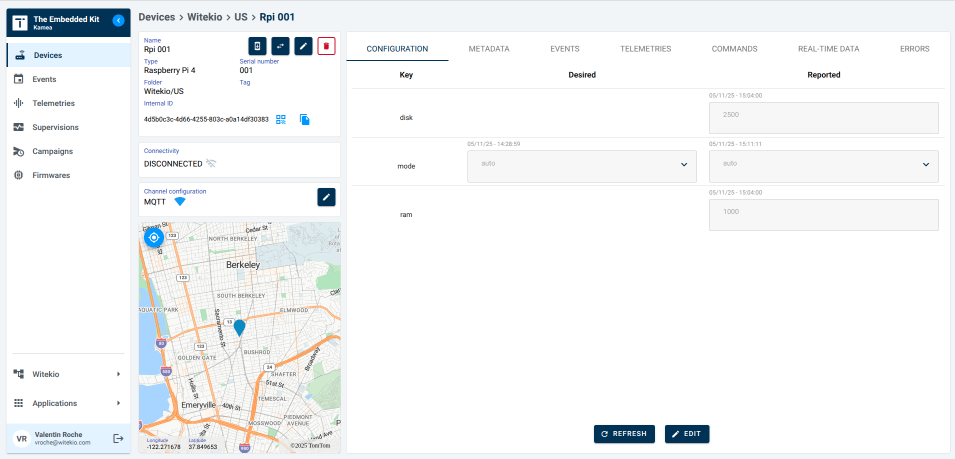
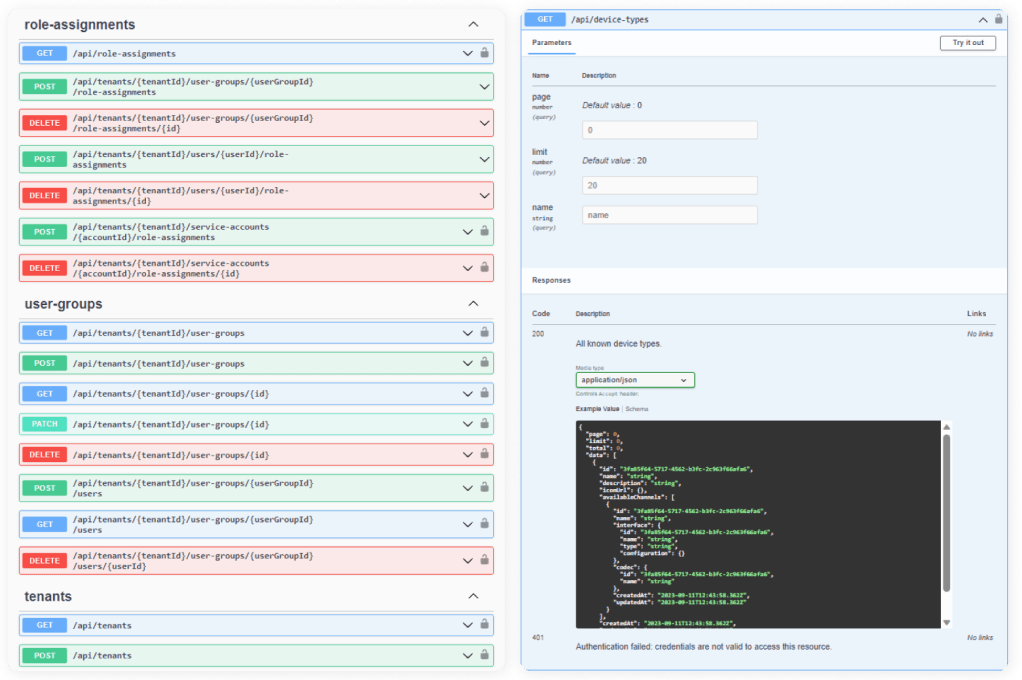
An emerging model combines the convenience of a ready-made platform with the freedom of source code ownership. Vendors deliver the platform’s source code, eliminating vendor lock-in and enabling unlimited customization. Kamea IoT device management platform is one example.
Pros:
- Full control over updates, integrations, and security.
- Predictable cost structure, often a one-time license fee for lifetime access instead of per-device charges (see business model details).
- API-first approach for easy business application development and deployment
- Maintenance and local support to reduce adoption friction and ensure long-term perennity.
Unlike SaaS, this approach aligns with device manufacturers’ need for long-term autonomy and cost efficiency.
Strategic considerations
Moving away from a SaaS IoT device management platform is not just a technical migration, it’s a strategic transformation that impacts your team and organization cost structure, compliance posture, and product scalability. Here are a few questions and angles to put down on paper to approach it:
Before migrating:
- Cost-Benefit Analysis: Compare total cost of ownership over 5-10 years. Include subscription fees, overage charges, and hidden costs like premium support.
- Scalability: Can the solution handle future device volumes?
- Compliance & sovereignty: Does it meet regulatory requirements? Where will data reside?
- Integration: Will the new platform integrate with your existing CI/CD pipelines, cloud services, and hardware? Note that OEM generally start with a pilot fleet before full-scale rollout to minimize risk.
Questions to ask:
- Who owns the data?
- How easy is it to customize?
- What happens if the vendor disappears?
Bottom line: Align your device management strategy with your long-term product roadmap, not just short-term convenience.
Conclusion
We now see a clear shift away from SaaS IoT device management platforms among device manufacturers. This move is driven by cost control, security, and strategic flexibility. Alternatives exist, including new approaches combining quick time-to-market with pre-built platforms and source code ownership like for Kamea. Have a look here to learn more.
References
- IoT analytics report, September 17, 2025: https://iot-analytics.com/what-happened-to-iot-platforms-whats-next/
- Microsoft announces Azure IoT Central product retirement, Microsoft, Feb 17, 2024: https://techcommunity.microsoft.com/blog/iotblog/microsofts-commitment-to-azure-iot/4059725
- Google Cloud will shutter its IoT Core service, Tech Crunch, August 17, 2022: https://techcrunch.com/2022/08/17/google-cloud-will-shutter-its-iot-core-service-next-year/


