What is a test bench?
A test bench serves as a controlled environment designed to facilitate the simultaneous evaluation of both hardware and software components in embedded systems.
By integrating these two critical elements, it simplifies the testing process, allowing for seamless detection of potential issues that typically emerge at the intersection of hardware-software interaction. This holistic approach not only accelerates troubleshooting but also mitigates risks, ensuring that problems are caught early, before they escalate.
In embedded systems, where malfunctions can lead to costly downtime or even hazardous conditions in industrial settings, a well-implemented test bench is indispensable for safeguarding both functionality and safety.

Why bench testing your embedded system?
In embedded engineering, particularly within Continuous Integration/Continuous Deployment (CI/CD) workflows, a test bench is vital. While testing software alone presents its own challenges, the addition of hardware testing introduces even greater complexity. Embedded systems sit at the intersection of software and physical hardware, making their testing inherently more difficult and requiring an environment that can handle both simultaneously.
A well-designed test bench offers several key advantages:
- Identifies issues early by testing software and hardware together
- Enables repeatable, automated testing scenarios
- Allows hardware tests that would be challenging or impossible to conduct manually
In high-stakes environments where even minor issues can lead to downtime or safety risks, these capabilities are invaluable for ensuring a robust, reliable system.
Test bench set up: key requirements
When building a test bench for embedded systems, it’s important to address both software and hardware requirements.
Embedded software requirements
- Testing software
Choosing the right software to test your embedded system is critical. Automated testing tools like Pluma are flexible enough to handle a wide range of system features and testing scenarios, from low-level components like bootloaders to high-level applications. Your embedded testing tool should be adaptable and scalable as your embedded system evolves.
- Automation tools
Automating your tests is a must for efficient CI/CD workflows. Tools like GitLab CI allow you to automatically trigger tests based on a schedule (e.g., daily builds) or upon the introduction of new features. This ensures continuous validation of your code and hardware integration.
- Test reporting
Comprehensive test reports provide insight into the testing process, helping you identify and isolate issues quickly. Proper reporting saves time and avoids the risk of overlooking important errors. Read more about test reporting formats here.
Hardware requirements
- Test runner
A device like a Raspberry Pi can act as a runner, executing tests on demand. This runner must be configured to communicate effectively with the device under test (DUT).
- Power Distribution Units (PDUs)
Proper control over the power supply to the DUT is critical. PDUs allow you to remotely reset devices and return them to a known state before each test, ensuring consistency in your results.
- Communication interfaces
Not all board features are accessible during testing. For instance, testing a bootloader often means SSH isn’t available. Your test bench should support multiple communication types, ensuring that tests can proceed regardless of the board’s state.
- Network management
Managing multiple devices over a network introduces challenges, especially when you need to avoid data collisions. A well-organized, secure network setup is essential to keep your tests running smoothly.
Using and evolving your test bench
As new hardware is introduced to develop a new product in your range, your test bench needs to evolve. You may need to write custom tests tailored to the unique requirements of this new board. Once functioning correctly, these tests can be integrated into your existing test plans.
The beauty of a test bench is that it can grow with your project. Most modern setups, integrating embedded testing tools, allow for an extensible approach, meaning you can add new boards and configurations without overhauling the entire system.
Take the recent addition of x86 boards within our Linux distribution, which required integrating PXE booting to reset the Yocto image. This was seamlessly incorporated into our existing test bench, while still maintaining a clear distinction between ARM-based and x86-based hardware testing.
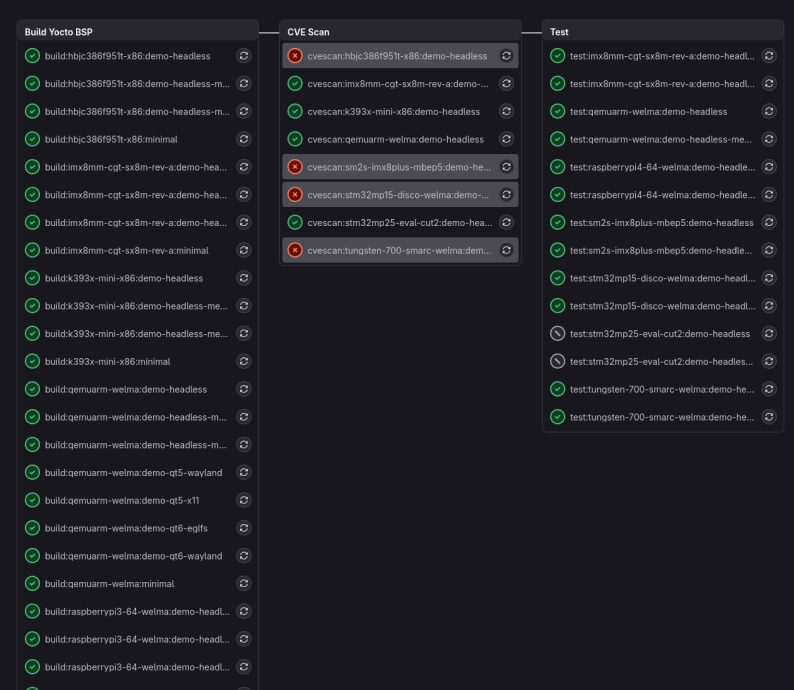
With automation tools like GitLab CI, tests can be executed on a specific schedule or upon each commit, providing continuous feedback on the stability of your codebase. And when issues arise, detailed test reporting within the CI pipeline makes tracking down the root cause much simpler.

How to keep your test bench scalable & well-organized?
No matter how sophisticated your test bench, it’s essential to maintain organization. Even basic factors like cable management can affect the scalability of your setup. Poorly managed cables can cause troubleshooting headaches, increase the risk of damage to equipment, and complicate future expansions of the test bench.
In the example below, an earlier test bench was fully functional but difficult to manage:

Expanding this setup to accommodate new boards was a major challenge. However, once proper cable management and organization were implemented, maintaining the boards and troubleshooting became significantly easier:

Bench testing, an investment in efficiency for your embedded developments
For embedded engineers, a test bench is not just a tool; it’s an investment in the efficiency and reliability of your development process. It allows for faster development cycles, reduces the risk of costly errors, and ensures your software and hardware meet the highest standards.
While setting up and maintaining a test bench requires time, effort, and sometimes significant resources, the long-term benefits far outweigh the initial investment. A robust, well-organized test bench:
- Prevents regressions by continuously validating code and hardware
- Speeds up troubleshooting by providing a consistent, automated testing environment
- Facilitates remote testing for developers without direct access to the hardware
By prioritizing organization, scalability, and regular updates to your test setup, you’ll ensure that your test bench serves as a powerful asset throughout your embedded software development process.

Brice Bischoff
Embedded Software Engineer